Challenge entry for the Bio+MedVis Challenge at IEEE VIS
t-SNE based Transfer Functions for Multi-attribute Volume Rendering
Bio+MedVis Challenge 2025 Award of Merit
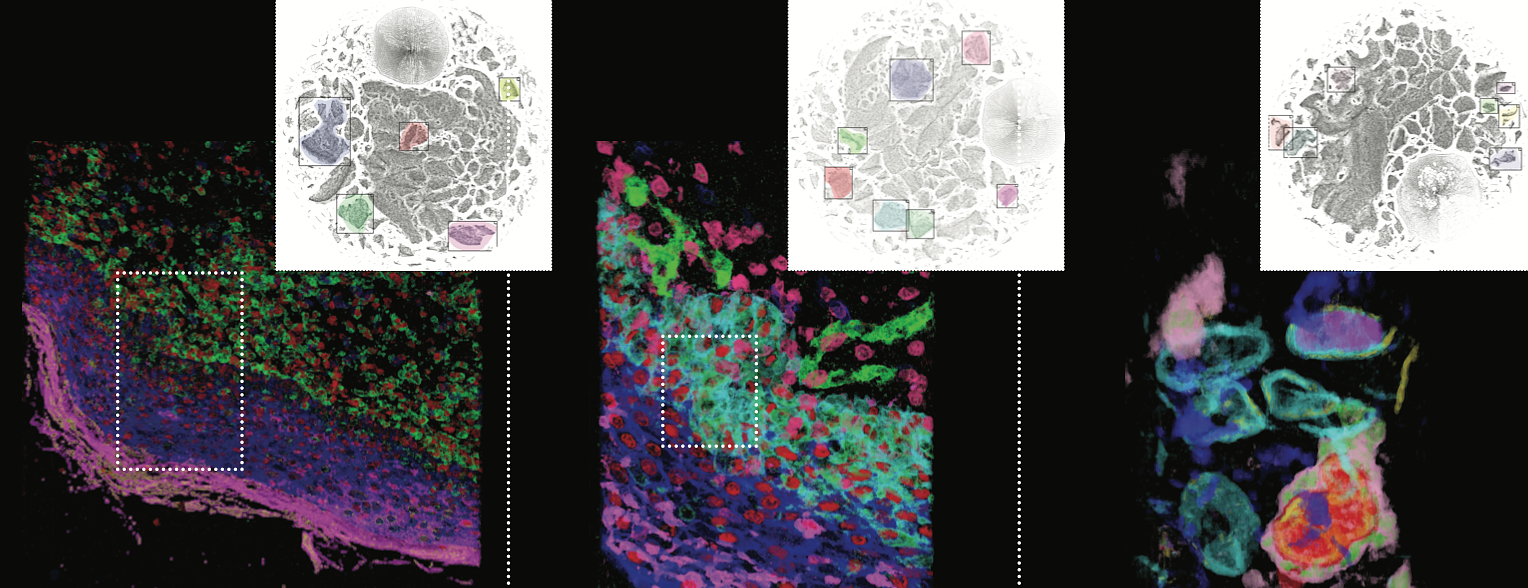
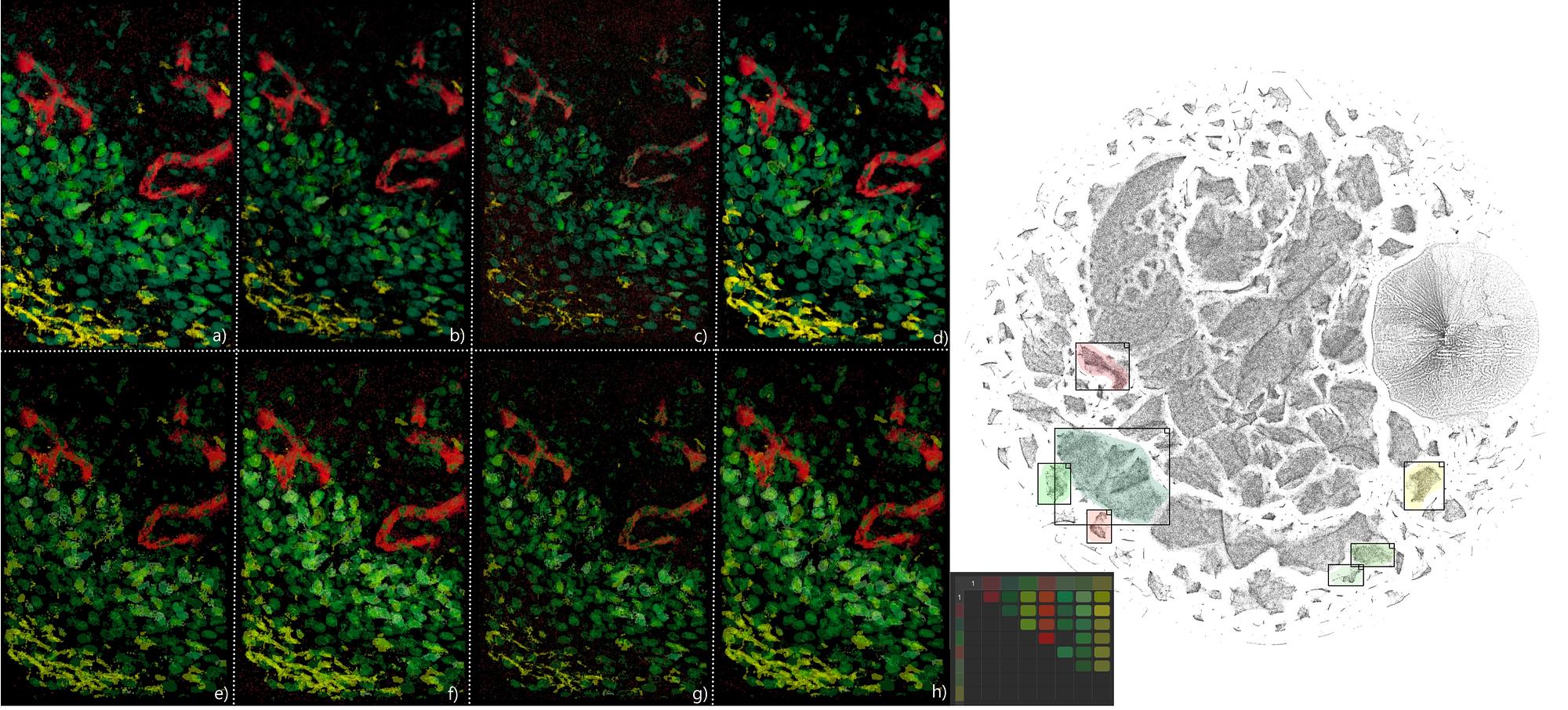
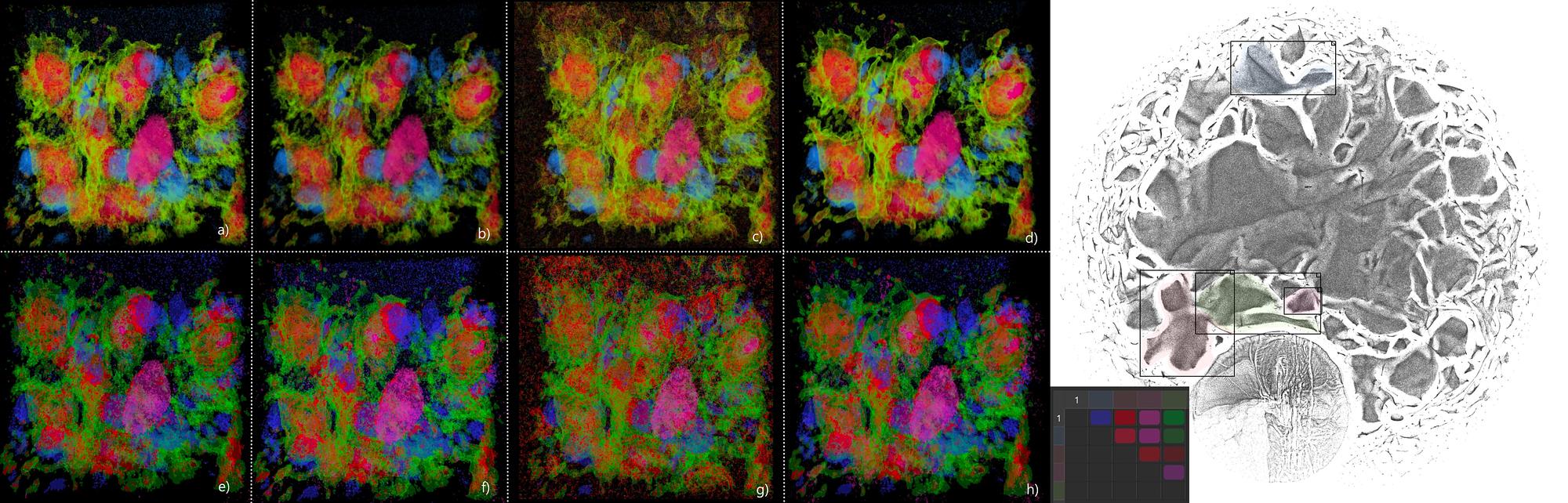
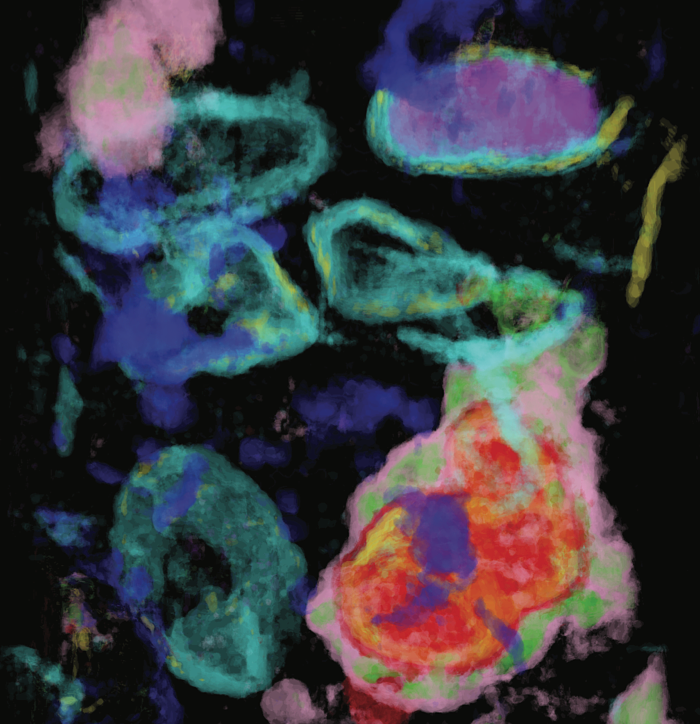
Standard direct volume rendering (DVR) methods are built for scalar data, such as medical scans. While the rendering algorithm extends to multi-dimensional data straightforwardly, the definition of transfer functions (TFs), mapping the input data (domain) to visual properties (co-domain, typically RGBα), is a key challenge. User interfaces for the design of TFs with a 1D or 2D domain are well established, however, designing TFs for higher dimensional domains, such as CycIF, is less explored. A relatively simple approach is to assign color hues to individual dimensions and use the intensity to define opacity. This approach provides only limited freedom and the results of mixed colors are hard to interpret. Explicit multi-dimensional TF design is often based on multi-dimensional data visualizations such as parallel coordinate plots or star coordinate plots. These methods, however, work best with no more than 10 to 20 dimensions. Another approach for TF design is using dimensionality reduction (DR) to reduce the data to 2D and use common 2D TF interfaces. This works well and has been applied with linear DR, such as principal component analysis (PCA). In the (spatial) single-cell field, however, PCA has been replaced by neighborhood-preserving DR techniques, such as t-SNE or UMAP, as they allow easy identification of different cell types in the low-dimensional embedding. However, due to their non-linear nature, these methods do not allow for easy lookup of new values, such as those created by interpolated sampling during DVR, in the existing embedding. We designed a t-SNE-based transfer function (TF), along with several volume rendering methods and apply it to the Bio+MedVis 2025 challenge CycIF data. In this work we focus on one method, providing very high visual fidelity. While this method comes with rather slow rendering times, combining it with another high-performance method during interaction provides the possibility for deployment in interactive visualization systems.
More Information
Gallery


Citation
BibTex
@misc{bib:snellenberg:2025,
    author       = { Snellenberg, Ravi and Höllt, Thomas },
    title        = { t-SNE based Transfer Functions for Multi-attribute Volume Rendering },
    venue        = { Challenge entry for the Bio+MedVis Challenge at IEEE VIS },
    year         = { 2025 },
    url          = { https://publications.graphics.tudelft.nl/papers/831 },
}