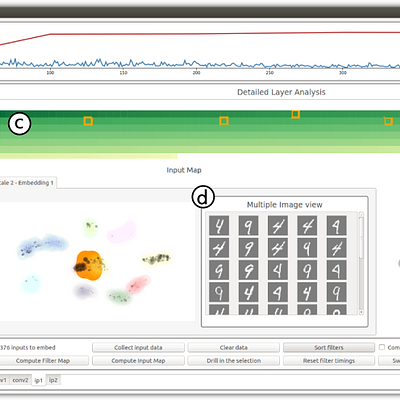
2020

Nicola Pezzotti, Julian Thijssen, Alexander Mordvintsev, Thomas Höllt, Baldur van Lew, et al.
IEEE Transactions on Visualization and Computer Graphics, 2020
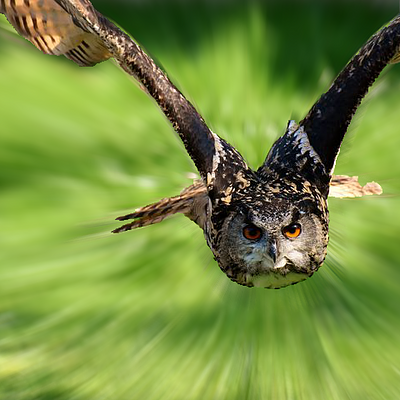
Xuejiao Luo, Nestor Z. Salamon, and Elmar Eisemann
IEEE Transactions on Visualization and Computer Graphics, 2020
Ruben Wiersma, Elmar Eisemann, and Klaus Hildebrandt
ACM Transactions on Graphics, 2020

2019

Leonardo Scandolo, Pablo Bauszat, and Elmar Eisemann
Computer Graphics Forum, 2019
Gerard Simons, Sebastian Herholz, Victor Petitjean, Tobias Rapp, Marco Ament, et al.
Computer Graphics Forum, 2019
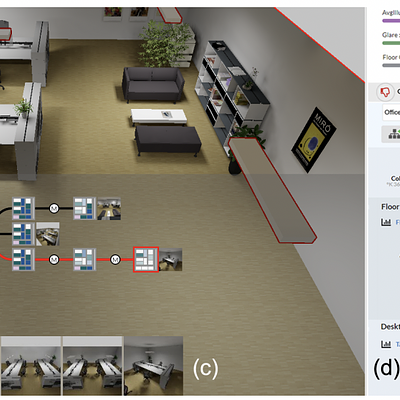
The components of LightGuider: (a) a 3D modeling view to place and modify luminaires, augmented with (b) a provenance tree, depicting several sequential modeling steps and parallel modeling branches, integrating information on the quality of the individual solutions, and providing guidance by pre-simulating and suggesting possible next steps to improve the design. A film-strip-like visualization (c) of screenshots helps to depict the evolution up to the currently selected state. A quality view (d) informs about the fulfillment level of the illumination constraints that need to be met, using bullet charts. Changing the weights of these constraints (e), and therefore, the lighting designer’s focus, triggers an update of the provenance tree node visualizations (reflecting the weights of the constraints in the distribution of the treemap space). Moreover, the defined weights are also considered in the generation of new suggestions, which are tailored towards satisfying constraints with higher weights.
Andreas Walch, Michael Schwärzler, Christan Luksch, Elmar Eisemann, and Theresia Gschwandtner
CoRR, 2019
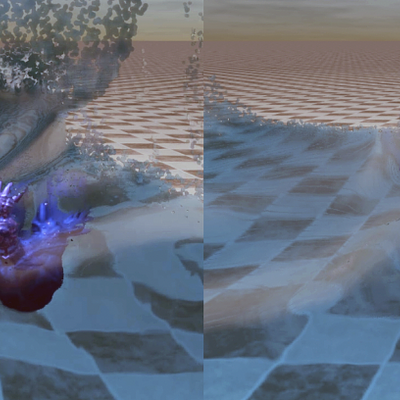
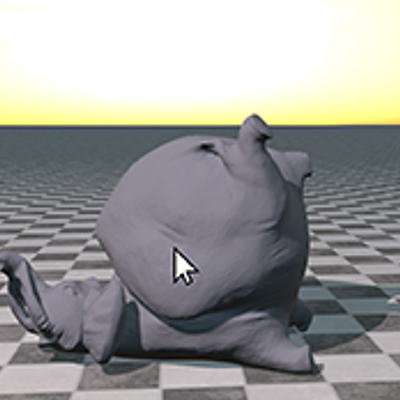
Two armadillos (274k tetrahedra) in a pool of water (633k particles) simulated at 60 FPS with a time step of 1/60s. Fluid-deformable interaction and (self-)collisions are handled. The user can interact with the scene through click-and-dragging the meshes.
Christopher Brandt, Leonardo Scandolo, Elmar Eisemann, and Klaus Hildebrandt
ACM Transactions on Graphics, 2019
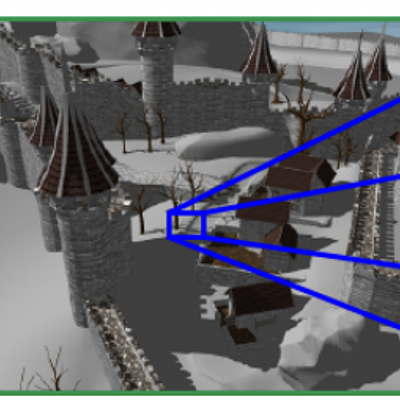
Pixel-perfect hard shadows produced by our method in the Citadel scene from different viewpoints.
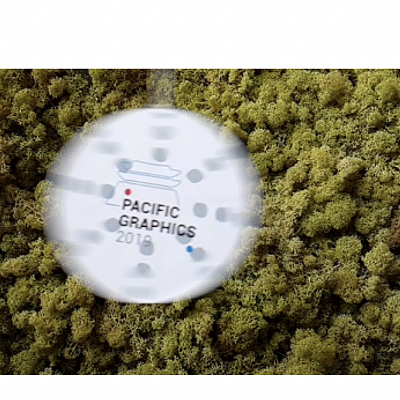
Baran Usta, Leonardo Scandolo, Markus Billeter, Ricardo Marroquim, and Elmar Eisemann
In Proceedings of High Performance Graphics (Short Papers), 2019
Left: single frame from 240Hz short-exposure video and a simulated long exposure at 30Hz by averaging 8 frames. Middle: Using the 240Hz input, our method enables mixing a long exposure in the periphery with a short exposure for the details on the pendulum. Via user annotations in the video, different shutter functions can be defined (top right). Annotations and shutter functions can be keyframed over time. Based on the annotations, our method defines an interpolated shutter function for each pixel (bottom right).
Nestor Z. Salamon, Markus Billeter, and Elmar Eisemann
Computer Graphics Forum, 2019
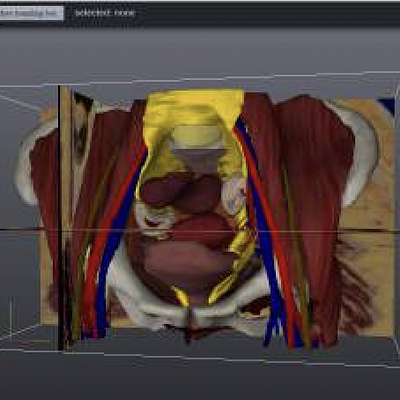
Screenshot of our interactive web application, which allows users to explore linked 2D and 3D anatomy contained in the VSP atlas.
Noeska Natasja Smit, Kai Lawonn, Anne C. Kraima, Marco C. Deruiter, Stefan Bruckner, et al.
In Proceedings of Eurographics (Dirk Bartz Prize), 2019
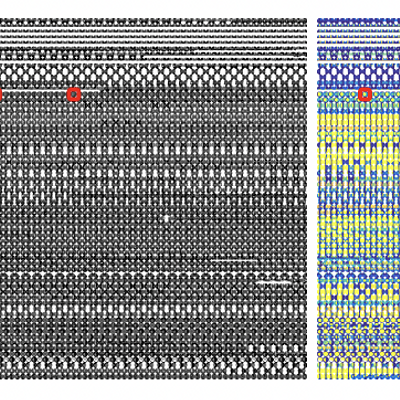
Indirect illumination computed from 1M animated virtual point lights (VPLs) with shadow maps of 162 resolution generated at interactive rates (100 ms, out of 194 ms for the image in total) by our many-view rendering algorithm (a). We show shadow maps of a subset of 2048 VPLs, for which many pixels are shared and rendered only once for multiple views (b). We highlight two close
Timothy R. Kol, Pablo Bauszat, Sungkil Lee, and Elmar Eisemann
Computer Graphics Forum, 2019
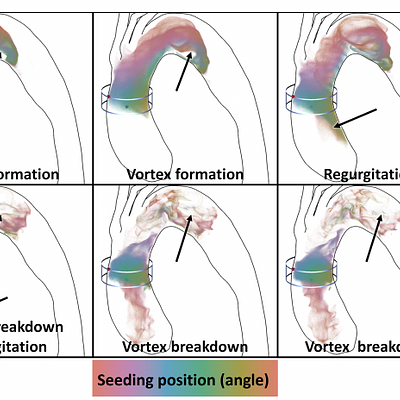
Streak visualization showing the formation, shedding and breakdown of a vortex in a patient with an aortic dissection in the aortic arch and regurgitation is present in the ascending aorta. The corresponding video can be found in the supporting material.
Niels de Hoon, Kai Lawonn, A.C. Jalba, Elmar Eisemann, and Anna Vilanova
In Proceedings of Visual Computing in Biology and Medicine, 2019
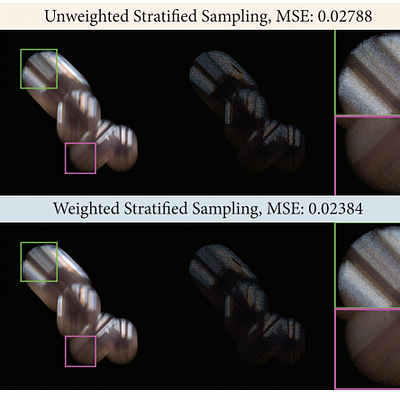
 Four highly glossy spheres moving in different directions with 64 samples per pixel. In each subfigure: corresponding render, difference with reference and highlighted regions.
Jerry Guo and Elmar Eisemann
CoRR, 2019
Cehao Yu, Elmar Eisemann, and Sylvia Pont
Perception, 2019
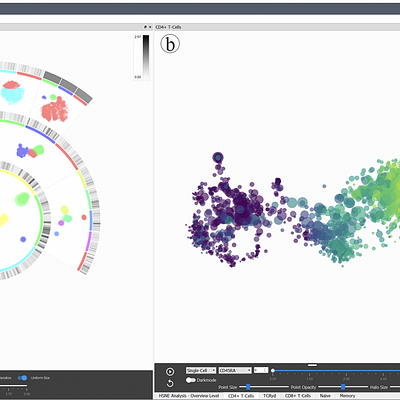
Cytosplore Screenshot with multiple views open; a) CyteGuide, b) HSNE plot, and c) cluster heatmap.
Thomas Höllt, Nicola Pezzotti, Vincent van Unen, Na Li, Frits Koning, et al.
In Proceedings of Eurographics (Dirk Bartz Prize), 2019
: Comparison between gradient-domain reconstruction and Monte Carlo denoising. For surface rendering, gradient-domain rendering is less efficient than Monte Carlo denoisers that use auxiliary buffers (NFOR [BRM∗ 16]) or histograms of path samples (BCD [BB17]). NFOR could also be applied to address noisy regions remaining in gradient-domain path tracing by using the reconstructed image as guiding features, leading to improved image quality (see G-PT + NFOR in the KITCHEN scene). For volume rendering, gradient-domain rendering is comparable to Monte Carlo denoisers, particularly with photon density estimation.
B. S. Hua, A Gruson, Victor Petitjean, M Zwicker, D Nowrouzezahrai, et al.
Computer Graphics Forum, 2019

2018

Sungkil Lee, Younguk Kim, and Elmar Eisemann
ACM Transactions on Graphics, 2018
Christopher Brandt, Elmar Eisemann, and Klaus Hildebrandt
ACM Transactions on Graphics, 2018
Nicola Pezzotti, Thomas Höllt, Jan van Gemert, Boudewijn P. F. Lelieveldt, Elmar Eisemann, and Anna Vilanova
IEEE Transactions on Visualization and Computer Graphics, 2018
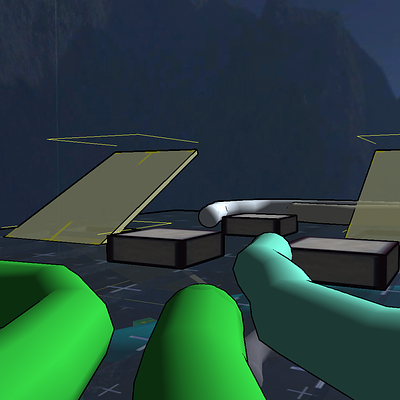
Ricardo Lopes, Elmar Eisemann, and Rafael Bidarra
IEEE Trans Games, 2018