2012

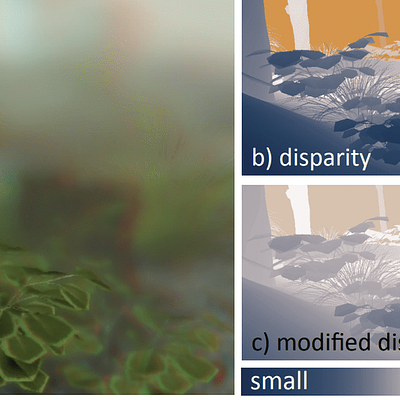
Real-time rendering applications exhibit a considerable amount of spatio-temporal coherence. This is true for camera motion, as in the Parthenon sequence (left), as well as animated scenes such as the Heroine (middle) and Ninja (right) sequences. Diagrams to the right of each rendering show disoccluded points in red, in contrast to points that were visible in the previous frame, which are shown in green (i.e. green points are available for reuse). [Images courtesy of Advanced Micro Devices, Inc., Sunnyvale, California, USA]
Daniel Scherzer, Lei Yang, Oliver Mattausch, Diego Nehab, Pedro V. Sander, et al.
Computer Graphics Forum, 2012
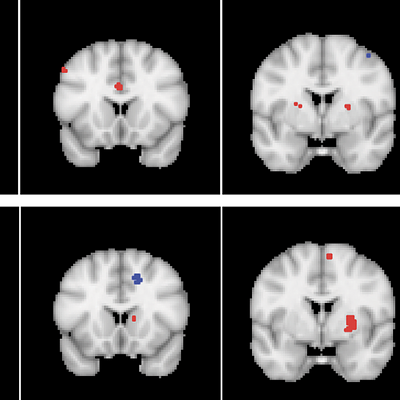
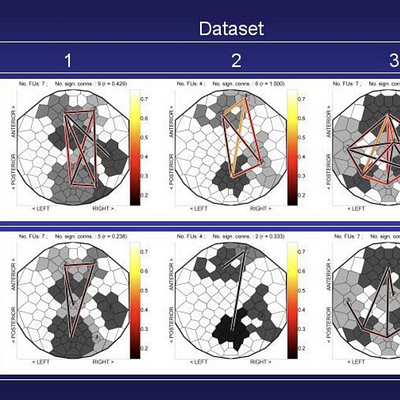
FU maps for multichannel EEG coherence visualization. Brain responses were collected from three subjects using an EEG cap with 119 scalp electrodes. During a so-called P300 experiment, each participant was instructed to count target tones of 2000Hz (probability 0.15), alternated with standard tones of 1000Hz (probability 0.85) which were to be ignored. After the experiment, the participant had to report the number of perceived target tones. Shown are FU maps for target stimuli data, with FUs larger than 5 cells, for the 1-3Hz EEG frequency band (top row) and for 13-20Hz (bottom row), for three datasets.
Hanspeter Pfister, Verena Kaynig, Charl P. Botha, Stefan Bruckner, V. J. Dercksen, et al.
CoRR, 2012
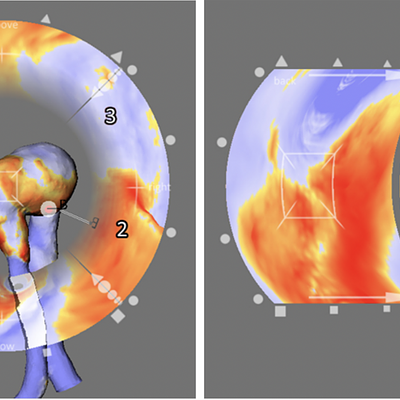
A 3D model of the relevant vascular anatomy is surrounded by map views that display scalar flow features of five sides (features at the left, right, bottom, and up side are shown at the corresponding ring portions). Scalar features of the backside are shown at the most right display. The lines pointing from the map portions to the 3D view indicate correspondences, where scalar features are shown in both views. If the user drags a point, representing an interesting feature from a map view to the center, the anatomical model is rotated to make that region visible. All map views change accordingly.
Anna Vilanova, Bernhard Preim, R.F.P. van Pelt, R. Gasteiger, M. Neugebauer, and Thomas Wischgoll
CoRR, 2012
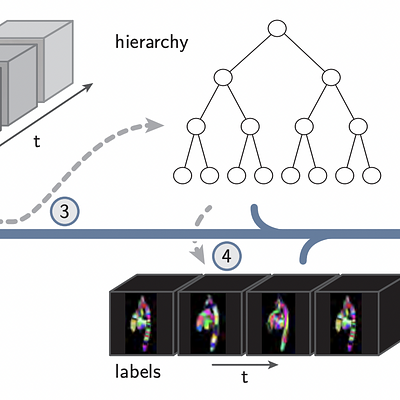
Overview of the visualization framework, based on spatiotemporal hierarchical clustering. The gray dashed arrows depict pre-processing steps. (1) A tMIP volume is generated, and (2) an iso-threshold captures the voxels that are clustered. (3) Next, the cluster hierarchy is constructed. (4) Using the cluster tree, labels are generated per cardiac phase. After preprocessing, the real-time visualization is generated using the available data structures, as depicted by the solid blue arrow.
R.F.P. van Pelt, S.S.A.M. Jacobs, B.M. ter Haar Romeny, and Anna Vilanova
Computer Graphics Forum, 2012
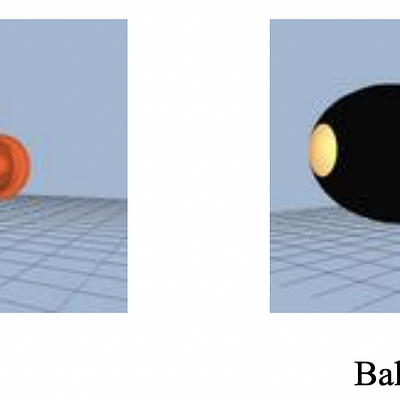
Lionel Baboud and Elmar Eisemann
In Proceedings of Intel Developers Forum, 2012
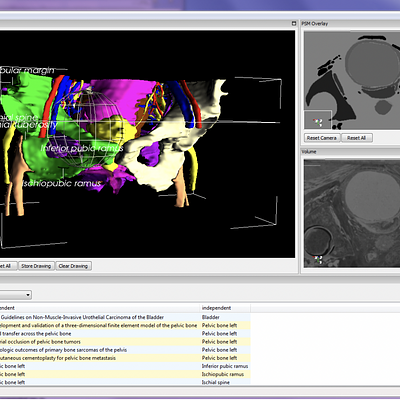
Orthopaedic workflow for hip prosthesis replacement: A 3D CT-scan (a) is segmented into labels (b). This discrete volume image is converted to a volume mesh (c). Based on medical simulations (d) [1], optimal implant design and positioning can be determined.
Christian Kehl, Daniel F. Malan, and Elmar Eisemann
In Proceedings of 3D NordOst Workshop, 2012
Example of a femur equipped with thermocouples, a close up of the measurement location.
Gert Kraaij, Daniel F. Malan, Huub J. L. van der Heide, Jenny Dankelman, Rob. G. H. H. Nelissen, and Edward R. Valstar
Med Eng Phys, 2012
R.F.P. van Pelt, H. Nguyen, B.M. ter Haar Romeny, and Anna Vilanova
International Journal of Computer Assisted Radiology and Surgery, 2012
Example of hybrid visualization of CSD [6] and 2nd order ODFs
V. Prckovska, M. Descoteaux, C. Poupon, B.M. ter Haar Romeny, and Anna Vilanova
New developments in the visualization and processing of tensor fields, 2012
Saggital view of DT ellipsoids generated for a healthy Human Brain
N. Sepasian, J.H.M. ten Thije Boonkkamp, and Anna Vilanova
SIAM J Imaging Sci, 2012
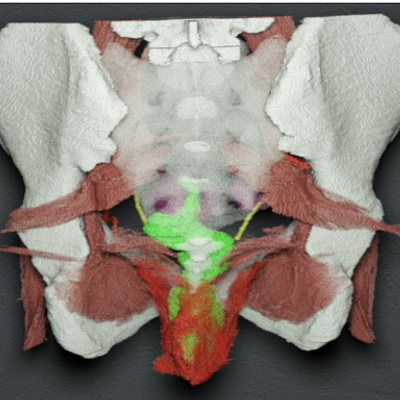
A distance query returns all information related to the structures inside the sphere.
Noeska Natasja Smit, Anne C. Kraima, Daniel Jansma, Marco C. Deruiter, and Charl P. Botha
In Proceedings of 3D Physiological Human Workshop, 2012
A screenshot of an interactive simulation with GALES. The 3D cloud field visualization is shown using volume rendering. During the simulation, the visualization can be actively zoomed and rotated to directly obtain insight into the simulation process.
Jerome Schalkwijk, Eric Griffith, Frits H. Post, and H.J.J. Jonker
Bulletin of the American Meteorological Society (BAMS), 2012
Collagen fibers in the adventitia of the carotid artery (sample 1). The same area was imaged at different pressure steps from 0 to 140 mm Hg; eight intermediate steps are shown. The gradual straightening of (individual) fibers is observed. The biggest configuration change mainly occurs between 40 and 80 mm Hg.
J.T.C. Schrauwen, Anna Vilanova, R. Rezakhaniha, N. Stergiopulos, F.N. van de Vosse, and P.H.M. Bovendeerd
Journal of Structural Biology, 2012
An overview of the application window with two datasets. Each dataset is opened in its own child window. Each child window contains of three views: the pixmap view on the top-left, the slice views on the top right and the anatomical view on the bottom.
Andre F. van Dixhoorn, Julien Milles, Baldur van Lew, and Charl P. Botha
In Proceedings of Visual Computing in Biology and Medicine, 2012
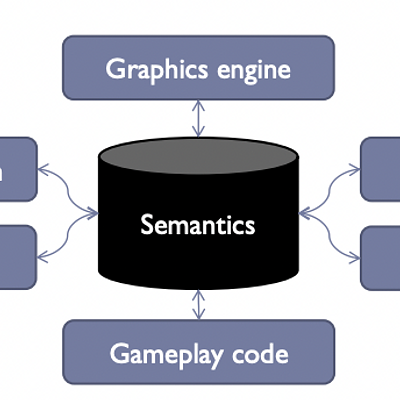
Editing huge game worlds in the Crytek Sandbox 2 editor can become very complex
Tim Tutenel
PhD Thesis, 2012
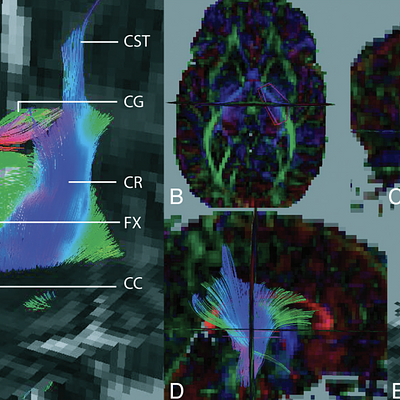
3D FT superimposed on 2D ADC maps. A, Whole-brain FT results, in a preterm infant at TEA. View from the front left. B, Definition of PLIC ROIs. View from the top (on the axial plane). ROIs superimposed on an FA-weighted color map. C, Definition of CC ROIs. View from the left (on the sagittal plane). ROIs superimposed on an FA-weighted color map. D, PLIC fiber bundle. View from the right (on the sagittal plane). ROIs superimposed on an FA-weighted color map. E, CC fiber bundle. View from the front left (on the sagittal plane). ROIs superimposed on an ADC map. CST indicates the corticospinal tract; CR, the corona radiata; FX, the fornix; CG, the cingulum
C. van Pul, B. van Kooij, L. de Vries, M. Benders, Anna Vilanova, and F. Groenendaal
AJNR Am J Neuroradiol, 2012
 Example of a transformation into a multi-component target
Marcelo Renhe, Antonio Oliveira, Claudio Esperança, and Ricardo Marroquim
In Proceedings of SIBGRAPI, 2012
Left: Brute force method. Center: Hierarchical template matching. Right: Floating Texture’s optical flow implementation
Matteo Dellepiane, Ricardo Marroquim, Marco Callieri, Paolo Cignoni, and Roberto Scopigno
IEEE Transactions on Visualization and Computer Graphics, 2012
Two examples of interactive visualizations made with the volume renderer of Kroes et al.
Charl P. Botha, Bernhard Preim, Arie Kaufman, Shigeo Takahashi, and Anders Ynnerman
CoRR, 2012