2015

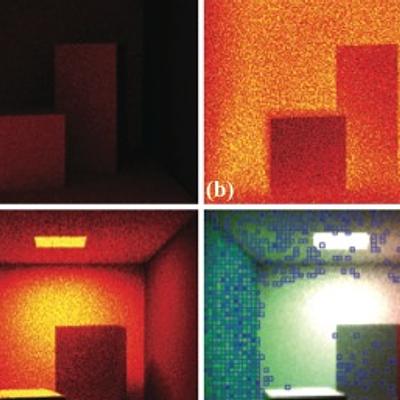
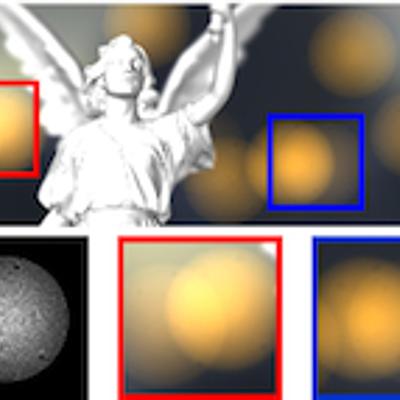
We compute the product of approximated visibility and environment map lighting in a stochastic Monte Carlo volume renderer to steer a joint importance sampling of the direct lighting. Our proposed two-step approach is well suited for dynamic changes in visibility and lighting functions due to a fast sweeping-plane algorithm to estimate visibility. The insets show how our technique (blue) achieves faster convergence with less samples compared to a uniform sampling (red) and importance sampling of the environment map (yellow). Here, 64 samples per pixel have been used. The Manix data set consists of 512×512×460 voxels.
Thomas Kroes, Martin Eisemann, and Elmar Eisemann
In Proceedings of Graphics Interface, 2015
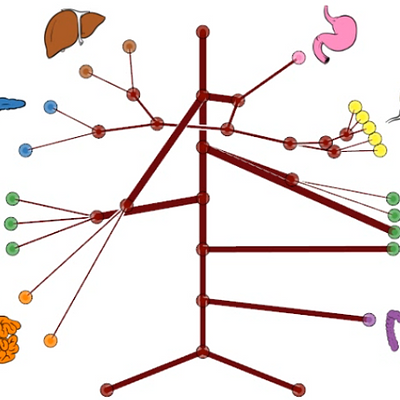
Different ways to visualize the expansion of “Detective #firstName# #surname# #sipped# the #coffee#. It was #coffeeJudgement#, like life”. Right: visualizing the grammar’s connectivity shows how each symbol (in dark blue) can expand to many different options (pale blue). Left: visualizing five sample expansions demonstrates where each story varies or remains the same. Bottom-left: fully expanded text, as it would be read by the end reader (Color figure online).
Kate Compton, Ben Kybartas, and Michael Mateas
In Proceedings of ICIDS, 2015
Exposure comparison
Michael Stengel, Pablo Bauszat, Martin Eisemann, Elmar Eisemann, and Marcus Magnor
IEEE Transactions on Visualization and Computer Graphics, 2015
Example of a notification that reminds the user that a stroll is available.
Jurgen van Schagen, Martijn Gribnau, Jean de Leeuw, Benjamin Los, Nick Cleintuar, and Rafael Bidarra
In Proceedings of CHI PLAY, 2015
Left: single scattering using the original geometry of the scene. The leaves of the tree block most of the light, causing only a subtle scattering effect. Right: scattering created by occluder manipulation. Using our system, an artist can easily add holes into the shadow map of the tree, causing an increased amount of and more interesting scattering effects. While physically incorrect, it is not visible to the viewer that the right image uses fake occlusion information. Insets show the scattering only. Surface shadows are created from the unmodified shadow map.
Oliver Klehm, Timothy R. Kol, Hans-Peter Seidel, and Elmar Eisemann
In Proceedings of Graphics Interface, 2015
Snapshots from an interactive shape interpolation session with five example poses of an armadillo shell model with 332k triangles. After a preprocess, our framework for nonlinear shape interpolation computes weighted average poses in real-time
Christoph von Tycowicz, Christian Schulz, Hans-Peter Seidel, and Klaus Hildebrandt
ACM Transactions on Graphics, 2015
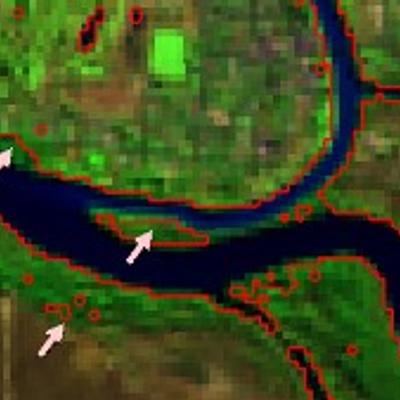
A visualization of a salt marsh located in the Netherlands, rendered with our framework.
Benny Onrust, Rafael Bidarra, Robert Rooseboom, and Johan van de Koppel
In Proceedings of Web3D, 2015
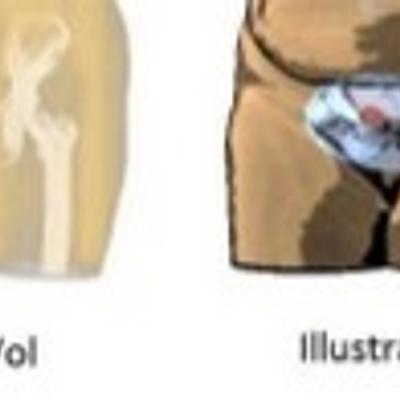
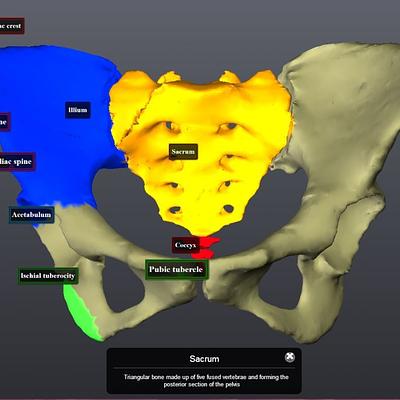
Left full exposure, pins can be deployed anywhere on the bone/cartilage. Right limited exposure. The orthopedic surgeon paints the areas on the bone that are deemed accessible during surgery, thus limiting where pins can be deployed
Thomas Kroes, Edward R. Valstar, and Elmar Eisemann
International Journal of Computer Assisted Radiology and Surgery, 2015
Petr Kellnhofer, Tobias Ritschel, Karol Myszkowski, Elmar Eisemann, and Hans-Peter Seidel
Computer Graphics Forum, 2015
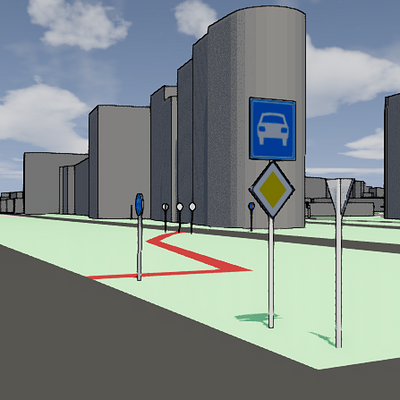
In-game view of a part of the resulting level of Figure 2
Daniel Karavolos, Anders Bouwer, and Rafael Bidarra
In Proceedings of FDG, 2015
Our initial TF for the PET dataset is defined using only a single value. After defining the α value, the TF can further adjusted if needed.
Kai Lawonn, Noeska Natasja Smit, Bernhard Preim, and Anna Vilanova
In Proceedings of Visual Computing in Biology and Medicine, 2015
A complex scene with fine details and global illumination. Left: Images rendered with PBRT [PH10] using 32 samples per pixel rendered in 2.5 minutes. Middle: Image reconstructed by our algorithm in 2.6 minutes including rendering and filtering. Right: Equal error image with 200 samples per pixel rendered in 12.7 minutes.
Pablo Bauszat, Martin Eisemann, Elmar Eisemann, and Marcus Magnor
Computer Graphics Forum, 2015
a) Foldios are designed in 3D. Print&fold layouts are automatically generated, including customized printable electronics for sensing and output. The technique enables quick, easy and inexpensive fabrication of a wide variety of folded interactive objects, including b) UbiComp devices, c) actuated shape-changing objects and d) lightweight paper crafts.
Simon Olberding, Sergio Soto Ortega, Klaus Hildebrandt, and Jürgen Steimle
In Proceedings of UIST, 2015
Our framework for spacetime optimization efficiently generates planned motion of complex articulated characters. Snapshots of an animation of a four-legged character performing a handstand followed by a twisting jump are shown.
Christian Schulz, Christoph von Tycowicz, Hans-Peter Seidel, and Klaus Hildebrandt
In Proceedings of Symposium on Computer Animation, 2015
The player has to avoid the frogs in a swamp and reach the end.
Kevin Allain, Bas Dado, Mick van Gelderen, Olivier Hokke, Miguel Oliveira, et al.
In Proceedings of SIVE@VR, 2015
Prototype Visualization
Michael Stengel, Steve Grogorick, Martin Eisemann, Elmar Eisemann, and Marcus Magnor
In Proceedings of ACM Multimedia, 2015
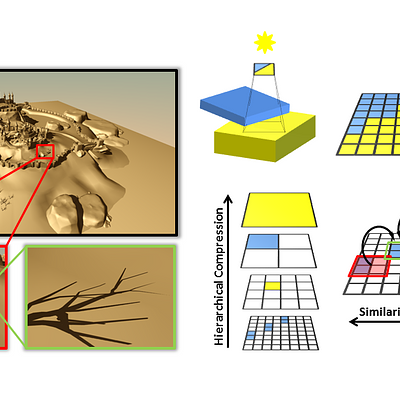
Depth Layering: While a single layer will result in a single average over all geometry (a), we can slice our scene in multiple depth layers to obtain averages for each layer separately (b).
Quintijn Hendrickx, Leonardo Scandolo, Martin Eisemann, and Elmar Eisemann
In Proceedings of High Performance Graphics, 2015
Typical 3D-UBM images of the four phantoms and for the rat right-side hindlimb lateral gastrocnemius at different view angles, generated after segmentation using the TurtleSeg software. (a) PH01LCY, (b) PH10SCY, (c) PH10SSCY, (d) PH10LCO and (e) lateral gastrocnemius.
Natália Martins, Luisa Carneiro, Hugo Dantas, Claudio Esperança, Ricardo Marroquim, et al.
Research on Biomedical Engineering, 2015
Antonios Liapis, Rafael Bidarra, Mark J Nelson, Mike Preuss, and Georgios N Yannakakis
Artificial and Computational Intelligence in Games: Integration (Dagstuhl seminar 15051), 2015
Comparison with Mean Shift on 2D data
Daniel van der Ende, Jean-Marc Thiery, and Elmar Eisemann
In Proceedings of DATA ANALYTICS 2015, The Fourth International Conference on Data Analytics, 2015